

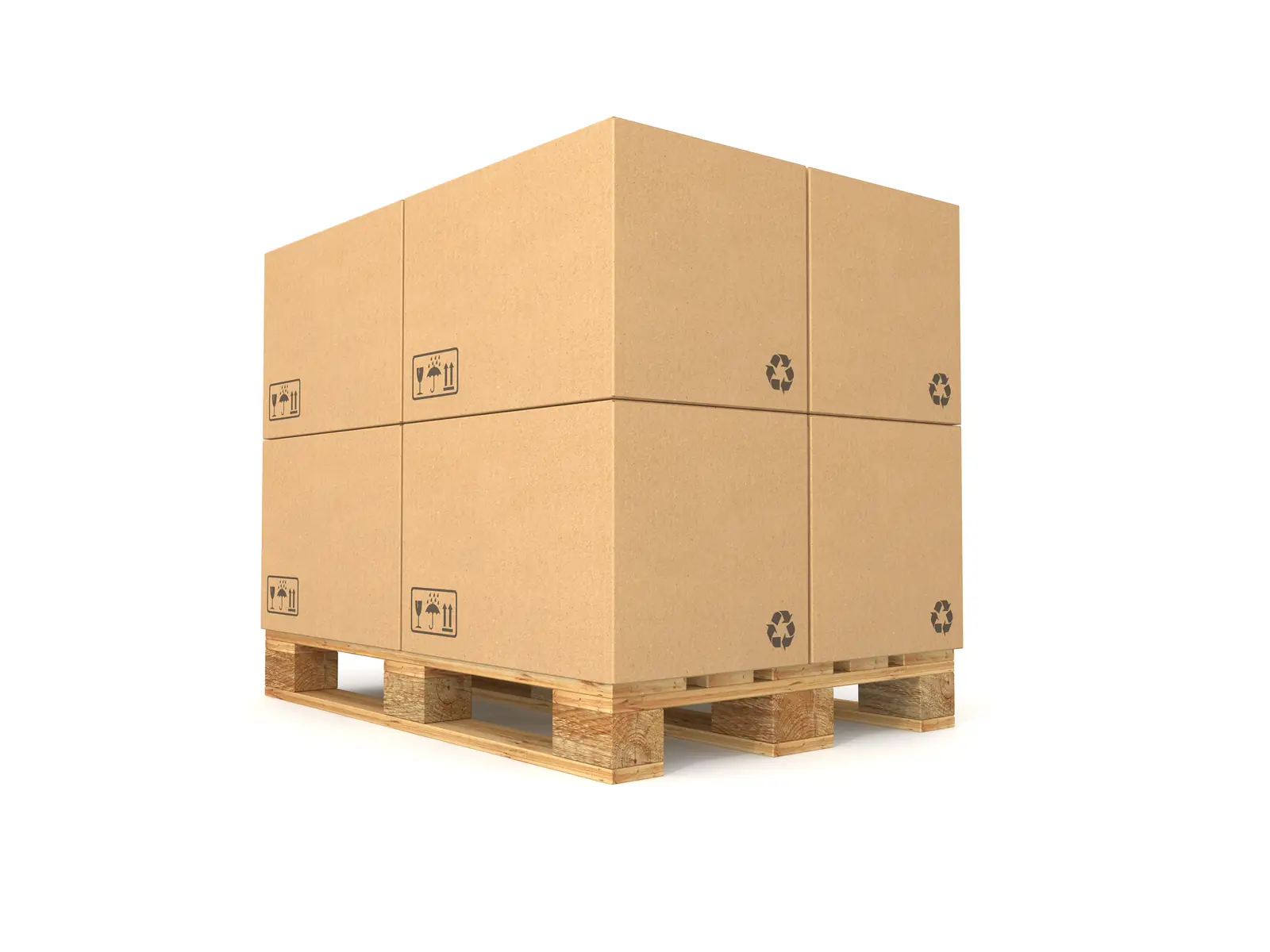
Whether you're shipping stock to a retailer, sending materials to a construction site, or fulfilling a wholesale order — knowing how to prepare a pallet for courier collection is the difference between a smooth delivery and damaged goods. A poorly prepared pallet can shift during transit, topple during loading, or even be refused by the courier at the point of collection.
At RGP TRANS LTD, we collect and deliver palletised freight every single day across the UK. We've seen it all — from expertly wrapped pallets that arrive in perfect condition, to unstable loads held together with a single strip of packing tape. This guide draws on our real-world experience to help you get it right the first time.
1. Choose the Right Pallet
Before you place a single item on a pallet, make sure the pallet itself is fit for purpose. A damaged or undersized pallet is the most common cause of load failure during courier transport.
Use a standard UK or Euro pallet. UK standard pallets measure 1200mm × 1000mm, while Euro pallets are 1200mm × 800mm. Both are widely accepted by couriers and fit efficiently into vans, Lutons, and lorries. Avoid odd-sized pallets unless absolutely necessary — they complicate loading and may attract surcharges.
Inspect the pallet carefully. Check for cracked or missing boards, protruding nails, splintered edges, and weak corner blocks. A pallet that flexes under weight or has a broken runner should be replaced immediately. If the pallet collapses during transit, your goods will be damaged and your insurance claim may be compromised.
Match the pallet to the load. A light-duty pallet rated for 500 kg won't survive a 900 kg consignment. If you're shipping heavy items like machinery, tiles, or bulk liquids, use a heavy-duty pallet and confirm your courier's vehicle capacity matches the weight.
2. Stack Your Goods Correctly
How you arrange items on the pallet directly affects stability during transport. A poorly stacked pallet is a hazard to the driver, to other consignments in the vehicle, and to your goods.
Heaviest items on the bottom. Place the densest, heaviest boxes or products on the base layer. This keeps the centre of gravity low and prevents the pallet from becoming top-heavy. Top-heavy pallets are prone to tipping — especially when the vehicle corners or brakes sharply.
Distribute weight evenly. Avoid concentrating all the weight on one side of the pallet. An unbalanced load puts uneven pressure on the pallet boards and makes the pallet difficult to manoeuvre with a pump truck or forklift. Aim for uniform weight distribution across the entire pallet surface.
Keep within the pallet footprint. Items that overhang the edges of the pallet are at high risk of catching on vehicle walls, other pallets, or loading equipment. They can also be crushed when the pallet is positioned next to another load. All goods should sit within the perimeter of the pallet base.
Don't exceed the safe working height. As a general rule, the total height of your palletised load — including the pallet itself — should not exceed 1.8 metres for vans or 2.2 metres for larger vehicles like Luton vans and lorries. Taller loads may not fit through the rear doors and will need to be booked on a suitable vehicle with sufficient internal load height.
3. Secure the Load
Stacking is only half the battle. Even a perfectly arranged pallet will shift during transit if it isn't properly secured. Inertial forces during acceleration, braking, and cornering can move individual items millimetre by millimetre until the entire load destabilises.
Use pallet strapping. Polypropylene or polyester strapping tightened with a tensioner tool is the gold standard. Run at least two straps horizontally around the load and, for taller loads, add vertical straps as well. The straps should compress the load enough that individual boxes cannot slide out but not so tight that they crush the packaging.
Consider edge protectors. For loads with sharp corners — tins, appliances, angular boxes — place cardboard or plastic edge protectors under the strapping. This prevents the straps from cutting into the packaging and distributes the tension more evenly.
Use anti-slip sheets between layers. If you're stacking smooth-surfaced items like plastic totes, tinned goods, or shrink-wrapped boxes, place anti-slip paper or rubber matting between each layer. This dramatically reduces horizontal movement and is one of the cheapest ways to improve load stability.
4. Wrap the Pallet Properly
Pallet wrap — also known as stretch film or stretch wrap — is the final protective layer. It keeps everything bound together, protects against dust and light moisture, and signals to the courier that the consignment is ready to travel.
Use the right grade of wrap. Machine-grade stretch film (17–23 micron) provides the best combination of strength and economy for hand-wrapping. For heavy loads or long-distance journeys, consider a thicker gauge or pre-stretched film. Avoid cheap domestic cling film — it lacks the elasticity and tear resistance needed for transport.
Wrap from the bottom up. Start by anchoring the wrap to the pallet base, not to the goods. This ties the entire load to the pallet. Then work upwards in overlapping layers, overlapping each pass by 50%. At the top, wrap over the edge to pull everything down. Finish by wrapping back down to the base and tucking the tail under a previous layer.
Apply sufficient tension. The wrap should be taut enough to visibly compress the load but not so tight that it distorts boxes. You should be able to press the wrapped pallet with moderate force and feel the contents resist as a single unit, not as individual items.
5. Label the Pallet Correctly
A courier cannot deliver what they cannot identify. Clear labelling is essential — and it's one of the most commonly overlooked steps in pallet preparation.
Include both collection and delivery addresses. Your pallet should have a label — or preferably two, on adjacent sides — showing the full collection address, the full delivery address including postcode, and a contact phone number for both. If the pallet is part of a multidrop run, label it with the specific drop number or reference.
Mark which way is up. If your goods are orientation-sensitive, clearly mark "THIS WAY UP" with arrows on at least two sides. This is especially important for appliances, electronics, and liquid containers.
Add handling instructions. If the load is fragile, heavy, or requires specific equipment, make it obvious. Labels like "FRAGILE — DO NOT STACK", "HEAVY — USE PUMP TRUCK", or "KEEP DRY" help the driver handle your pallet appropriately at every stage of the journey.
Use waterproof labelling. Pallet labels printed on standard office paper will disintegrate the moment they encounter rain, condensation, or a damp vehicle floor. Use waterproof adhesive labels or place paper labels inside a clear plastic document wallet firmly taped to the pallet wrap.
6. Book the Right Vehicle for Your Pallet
Even the best-prepared pallet needs the right vehicle. Booking a van that's too small is a guaranteed delay — the driver will arrive, realise the pallet won't fit, and leave without your goods.
Know your pallet dimensions before booking. Measure the length, width, and height of your loaded and wrapped pallet, not the dimensions of the pallet base alone. Tell your courier the actual dimensions — not estimates. A 10 cm discrepancy can be the difference between fitting and not fitting.
Match the pallet count to the vehicle. Our fleet handles everything from single-pallet deliveries to full lorry loads:
- Small Van — up to 1 pallet, 400 kg (good for documents, small parcels, sample consignments)
- Large Van — up to 3 pallets, 1,200 kg (ideal for B2B freight and construction materials)
- Extra Large Van — up to 4 pallets, 1,100 kg (best for long items like pipes and carpets)
- Luton Van + Tailgate — up to 6 pallets, 1,000 kg (perfect for bulky items requiring a tail lift)
- 7.5t Lorry — up to 10 pallets, 2,800 kg (bulk raw materials and stock replenishments)
- 18t Lorry — up to 14 pallets, 9,000 kg (high-volume B2B distribution)
- HGV / Arctic — up to 26 pallets, 26,000 kg (full trailer loads and maximum-volume runs)
View the complete fleet with dimensions to find the right match for your palletised consignment.
Common Pallet Preparation Mistakes to Avoid
Over the years, we've seen the same mistakes repeated again and again. Here are the most frequent — and how to avoid them:
- Using a damaged pallet. A cracked board or missing block will fail under load. Always inspect before use.
- Overloading beyond the pallet rating. A 500 kg pallet carrying 800 kg of tiles is a collapse waiting to happen.
- Wrapping the goods but not the pallet base. If the wrap doesn't anchor to the pallet, the load can slide clean off the base during transit.
- Stacking loosely. Gaps between boxes allow individual items to shift and crush each other. Pack tightly.
- Overhanging items. Anything protruding beyond the pallet edge will almost certainly be damaged during loading.
- Booking a vehicle that's too small. Check your pallet height against the vehicle's internal load height before booking.
Ready to Ship Your Pallet?
Proper preparation takes 15 minutes and can save you hundreds of pounds in damaged goods, failed collections, and wasted time. Get it right and your pallet will travel safely from door to door — whether it's going across town in a small van or across the country in an HGV.
At RGP TRANS LTD, we provide nationwide palletised courier services with vehicles ranging from small vans to 26-pallet artics. Every consignment is tracked in real time, and we provide photographic proof of delivery at every drop.
Need a Pallet Collected?
Request a free, no-obligation quote — our team will match the right vehicle to your palletised load and confirm collection within minutes.